What’s new with @ultreia - https://ultreia.me?

v1.0-beta9 - Welcome Tour & Update Glow
- New users now get a quick guided tour of the map controls on first visit
- When a new app version is available, the menu button pulses amber to let you know
- Tapping Reload or Restart App in the menu clears the update indicator
- check out https://guide.ultreia.me

v1.0-beta7 - The BookAlbergue Version
- Ultreia is now partnering with BookAlbergue, a local Galician alternative to big-name booking platforms
- Albergue pages now link to BookAlbergue for reservations where available
- Version history tracking for all data changes, so edits are transparent and reversible

v1.0-beta6.6 - Admin & Data Improvements
- About, Contact, and Support links now open on the guide site
- Staff users now have view-only access in the admin panel
- “Find in OSM” on the albergue edit screen now uses local data instead of the Overpass API
- Fixed OSM links across the admin interface

v1.0-beta6.5 - Survey Tools
- Simplified completeness checks to focus on what matters: price, contact info, and bed count
- Switching survey modes updates the URL so you can bookmark or share a specific tool
- see: https://ultreia.me/survey

v1.0-beta6 - Town Search
- Search for any town, village, or city along all 7 Camino routes
- 1200+ places now in the database across Francés, Norte, Primitivo, Portugués, Inglés, Invierno, and Fisterra
- Search results show which routes each town is on (e.g. “Melide” shows “Camino Francés, Camino Primitivo”)
- Tap a result to fly to that location on the map
- Falls back to general map search when no Camino towns match
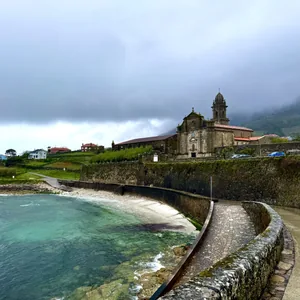
Hospitaller Church, Cizur Menor

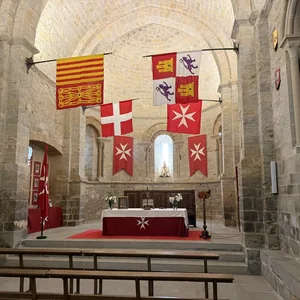
Just outside Pamplona, in Cizur Menor, the Camino slips past a place where medieval practicality and spiritual marketing quietly shook hands: the church and former hospice of the Knights Hospitaller, today remembered through the Iglesia de San Miguel and the adjacent pilgrims’ albergue.

Strip away the romance for a moment. The Knights Hospitaller—later known as the Order of Malta—were not wandering mystics with good intentions. They were a disciplined, international organization running a medieval logistics network. Their original job description was simple and brutally honest: care for pilgrims, protect routes, manage assets, and stay solvent while doing it. The Camino was perfect territory. Endless foot traffic, high injury rates, sickness, theft, exhaustion—demand guaranteed.

Cizur Menor sat exactly where it needed to be: just after Pamplona, when the first euphoric optimism of pilgrims met the reality of sore feet and bad decisions. The Hospitallers established a hospital and shelter here by the 12th century, offering food, beds, and care under the protection of Saint Michael, the archangel who specializes in drawing hard moral lines with a sword. That dedication is not subtle. This was a frontier between safety and exposure, order and chaos.

The church of San Miguel that remains is Romanesque at heart: thick walls, small windows, a geometry designed to endure rather than inspire. It was not built to impress God; it was built to outlast weather, war, and pilgrims who collapse into walls. Think less cathedral, more bunker with theology.

The albergue, still functioning today, continues the original mission with modern humility. No theatrics. No spiritual cosplay. Just beds, water, shelter, and the quiet understanding that pilgrims don’t need enlightenment at this stage. They need rest. This continuity is the real marvel. Most medieval institutions vanished or mutated beyond recognition. Here, the core function survived: people walking west arrive broken; people leave slightly less broken.

The Hospitallers weren’t altruists in the modern sense. They were systems thinkers. Care created loyalty. Loyalty stabilized routes. Stable routes created influence. Influence kept the order powerful enough to keep caring. It’s a feedback loop, not a halo. Today, the Orders of St. John and the Orders of Malta (Maltese, Johanites a split that happened with the Reformation) serve in thousands of institutions, from operating ambulance services in Britain, Canada, Australia, Germany, and more, to hospitals, shelters for the frail, weak, abused, and homeless, food kitchens and pantries and, of course, still cater to pilgrims on any major pilgrimage route.

From the outside, Cizur Menor looks like a modest village stop. From the inside of history, it’s a node in a pan-European network that understood something we still struggle with: infrastructure is compassion made durable.

Pilgrims today pass through, snap a photo, stamp a credential, and move on toward Puente la Reina. The stone doesn’t object. It has seen crusaders, plague victims, barefoot penitents, Instagram hikers, and probably worse. It remains, doing what it has always done—standing where humans tend to falter, quietly refusing to disappear.