Recently we have seen a massive spike of calls to /api/v1/instance/domain_blocks, from all kinds of players, including Google, Microsoft, Chinese IP addresses, a server farm in Cyprus and one belonging to an online casino farm on Malta. Those happen on medic.cafe as well as #Hule, which does not support domain blocks (yet).

I am wondering: what is the value of those (~4k today) spiders? Who would benefit from knowing which instances are blocked by whom? I am aware, that there’s a bot run by an “edgy” MAGA/Hatepost/Memefarm instance, but this massive interest across actors makes me wonder.

Open Source printer using HP cartridges (now refillable, because the “DRM” part doesn’t catch). Not just that, it’s repairable, open, and looks effing amazing. Time to get buildin’, I guess.

2025 we had 1.5 million(!) attempts at logging into medic.cafe (our Fediverse server) from Russian, North Korean, and Chinese actors.

That’s 4100 per day, 171 per hour, 2.8 per Minute.

All of them trying to either directly dump payloads, exploit known issues with third party software (MongoDB right now), or brute force admin passwords.

This is not accounting for VPN’d connections and compromised servers in the US, Europe, or elsewhere in the world. JUST the ones with Russian, NK, or Chinese IP addresses. And, of course, it could also be Berlin based bad actors using compromised servers in Russia or China, but I’d hedge a bet that the former (them using compromised US systems) is more than the latter.

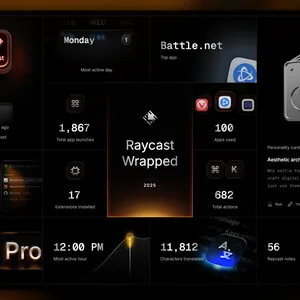
Raycast Wrapped

My @raycast Wrapped 2025. I went back to Raycast in September or so, after a year of experimenting with other launchers or wrangling my own with Tahoe’s new Spotlight, and since then it’s a weekly back and forth of “how can I cram that into Rayast.”

Raycast Notes have replaced my vim based notes, Hyper-Key manages my Windows, and starts my apps, “Ask Browser” turns wall of text in nicely formatted output with TLDR and Source lists, and somewhere in there it also manages my Home Assistant, Music, and Schedule.

That’s the good news. The bad news are, this seems to have become this year’s “vim” of last year, where I spent more time configuring than using it, because every day there’s some cool new shit I want to add.

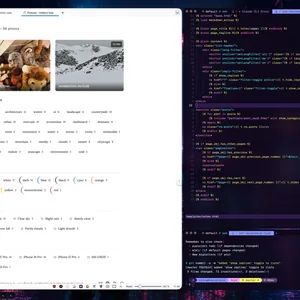
My "development environment" - Vivaldi, WezTerm, nvim, AeroSpace and SimpleBar for tiling window manager.

This morning I was asked, if I vibe-coded all or parts of Hule. The asker wasn’t accusing me, they wanted to know if that was possible, since they had a few ideas for the app but weren’t familiar with Python.

Short answer: No. I don’t trust AI generated code.

Longer answer: No, but it depends.

I use a local LLM with nvim to suggest code completions and keep track of things. For example, I keep all my :root variables in one central location, and more often than not, I do not have to type out long CSS blocks, since the LLM understands that .reply-card:hover wants to invert on hover and suggests an according block. Same for git commits, which I instruct an LLM to look over the code and create good commit messages.

I also used claude and codex for code reviews more than once. I, too, am learning to do this (I am a medical humanist and emergency medicine man, not a coder, after all), and especially Claude’s suggestions and warnings of n+1 mistakes saved me hours, if not days, of coding and bug hunting. Codex on the other hand understands ActivityPub better and was able to point out, that I was not sending tags and mentions correctly.

Finally, I let claude write the scripts to use Claude to create meaningful commits. After doing so, I had to manually fix so many things, I was cured of my vibe coding curiosity.

Wow, iOS 26.2 is 11.5 GB on my iPhone 17 Pro. That’s 11 GB of essentially just bugfixes and Apple Watch connectivity fixes. At least Live Translations come to Europe.

Little background: Live Translations were unavailable in Europe, because Meta demanded access to the data (not the functionality). Meta is essentially abusing the EUs DMA to get more user data they had been blocked from by Apple (and Google, for different reasons).

Sometimes we’re our own worst enemies.

Amiga vs AGI

Way back when, I was a member of a small Amiga Cracking/Demo group, that over time focused more and more on Demo and less and less on Cracking. Demo was, where it was at, we’d travel to Sweden and Italy and many other places, spending nights sleeping in train stations and city parks having spent all our money on the train ticket and McDonalds… it was a glorious time.

Then came the DCKs, the Demo Construction Kits. And the Amos Basic Compiler Templates. Both allowed everyone to build basic Demos. Scrollers, bouncers, music, even interactive elements. So we upped our game, added impossible sprite movements, kicked Copper and Blitter into places they weren’t supposed to go, tickled more music out of the system than it was meant to play.

DCK often caught up to us a few months later. My proudest moment, not going to lie, was when a German Amiga Magazine advertised a Disc containing a DCK to make “Demos just like Lowkey.” Another Demo Team, DOC (whom I hated with the passion of a thousand seething suns for having insanely racist “jokes” in their demos) even published their own DCK. I wonder what became of Michael H., and if he’s still a racist…

Long story short… that’s how Vibe Coders feel. It’s not that different from typing in five pages of hex numbers with control number/checksum every 16 numbers (anyone except me remembering those from C=64 and Amiga Magazines?) or running a DCK: the output might look like last year’s hype beast, but the creator doesn’t understand thing one about the code. And, frankly, understanding the machine, learning its nooks and crannies, that was what it was all about for me. Some Demos made it big, some fizzled, but very few of those moments stand out. What does stand out, are the nights, smoking rolled Gauloise Black in my room in the basement, hunched over an Amiga 500 connected to a shitty monitor, trying to edge out one more raster to close a loop or pouring over disassembler printouts to understand, how a game enforced its copy protection. And those Demos, the “Zero Day” ones, were the successful ones. If everyone can replicate last year’s peak code, those who create this year’s will be the winners.

I could have spent my youth making DCK demos and probably get laid more and earlier. I could have made money selling cracked games or creating demos for others. But that didn’t feel satisfying enough. I wanted to own what I did. And, sooner or later, when everyone vibe codes, that’ll be it again. In 5 years, all those slop apps with purple gradients and emojis, telltale signs of Claude or Codex, will be forgotten. Hand made code will survive. Because it will be at the apex of development, not two years behind. And, more importantly, it’ll fill its makers with pride.
The main focus of the image is the StreetPass app interface, which displays user accounts in the fediverse.

StreetPass is a tiny extension for Chrome, Firefox, and Safari, that shows Fediverse verification rel=”me” links when hitting a websites, allowing you to discover a website author’s fediverse profile and follow them there.

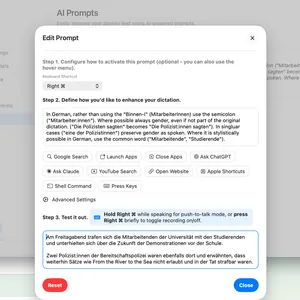
Easily improve your spoken text using AI-powered prompts.

Edit Prompt
Step 1. Configure how to activate this prompt (optional - you can also use the hover menu).
Keyboard Shortcut
Right ⌘

Step 2. Define how you'd like to enhance your dictation.
In German, rather than using the "Binnen-I" ("MitarbeiterInnen") use the colon ("Mitarbeiter:innen"). Where possible always gender, even if not part of the original dictation. ("Die Polizisten sagten" becomes "Die Polizist:innen sagten"). In singular cases ("eine der Polizistinnen") preserve gender as spoken. Where it is stylistically possible in German, use the common word ("Mitarbeiter;ende", "Studierende").

Step 3. Test it out.
Hold Right ⌘ while speaking for push-to-talk mode, or press Right ⌘ briefly to toggle recording on/off.

Am Freitagabend trafen sich die Mitarbeitenden der Universität mit den Studierenden und unterhielten sich über die Zukunft der Demonstrationen vor der Schule. 
Zwei Polizist:innen der Bereitschaftspolizei waren ebenfalls dort und erwähnten, dass weiterhin Sätze wie From the River to the Sea nicht erlaubt und in der Tat strafbar waren.

On Mac and iOS, Spokenly does a hell of a good job using local models to enable voice dictation. Some of my patients with ALS or Huntington’s disease can dictate whole letters, even with broken speech and often long pauses between words.

Even better, it’s all local; no AI credits or remote models are needed, and it works well on an M1 Pro or even an M1 iPad (iPad only remote models for $9/month).

Even better, I could train it to gender ;)

Know what pisses me off the most? If I have to go hunt for the studies that underlie an article. Hiding it between links to your own content is super bad behavior, The Conversation. Also, writing a lot about the Fediverse but calling it “Mastodon” and then not having a prominent Mastodon account, that’s annoying, too.

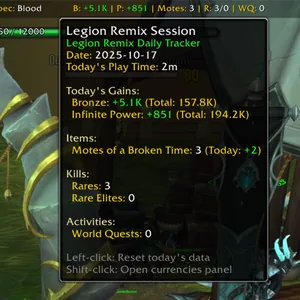
Spec: Blood
B: +5.1K | P: +851 | Motes: 3 | R: 3/0 | WQ: 0
Legion Remix Session
Legion Remix Daily Tracker
Date: 2025-10-17
Today's Play Time: 2m
Today's Gains:
Bronze: +5.1K (Total: 157.8K)
Infinite Power: +851 (Total: 194.2K)
Items:
Motes of a Broken Time: 3 (Today: +2)
Kills:
Rares: 3
Rare Elites: 0
Activities:
World Quests: 0
Left-click: Reset today's data
Shift-click: Open currencies panel

I know, I am probably the only person admitting to playing WoW, but if you’re secretly also playing the game and use TitanPanel, I’d have something for you: LegionRemixer, a simple tracker for your Remix currencies and progress. Just in case you are, you know… And if you are, let’s Mythic.

Ich hätte wirklich nicht gedacht, dass Vivaldi mir so gut gefallen könnte, wie es das tut. Nachdem ich endlich herausgefunden habe, wie ich die kleinen Sachen, die mich stören, via chrome.css in Schach bekomme, und Passkeys und iCloud Keychain richtig tun … Ja, ich glaube ich habe meinen neuen Browser gefunden.

Hätte Apple den Compact Mode nicht mit macOS 26 abgeschafft, wäre das nie passiert.